Brain Emulation Challenge
Generate virtual measurements from known circuits and compare reconstruction methods.
A guide to the roadmap, development platform, and benchmarks for treating whole-brain emulation (WBE) as a measurement, identification, and validation problem.
Carboncopies Foundation supports research toward substrate-independent minds, with WBE as a technical pathway. Its research page emphasizes converting measurements into executable models and validating the results. This is a personal site edited by yasufumi-nakata. Carboncopies Foundation is cited as a source of public material, not presented as the site’s publisher or editorial supervisor. This account does not represent an official statement or endorsement by the Foundation.[1][2]
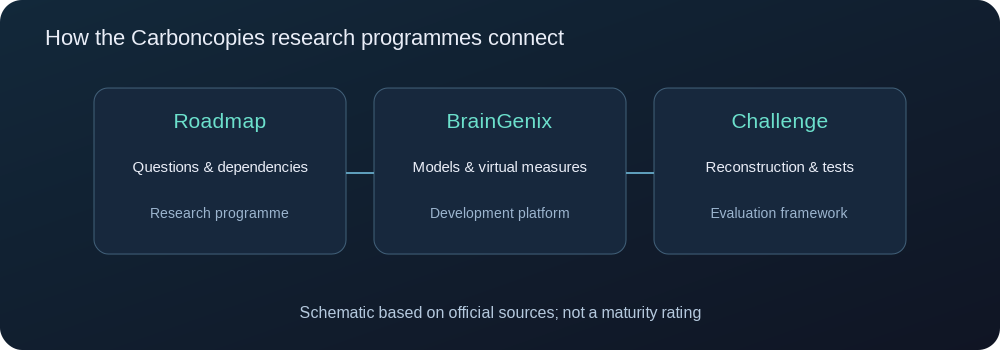
Generate virtual measurements from known circuits and compare reconstruction methods.
A development platform for models, execution, and experiments; its existence does not establish a finished upload system.
An ongoing update of technical requirements and research needs, building on the 2008 roadmap.
We cannot know every true parameter of a biological brain. A synthetic circuit allows ground truth to be retained while participants receive only observations. The Challenge reconstructs models from virtual structural and activity measurements and compares structure, dynamics, and behavioural or input–output performance.[3]
These steps are this guide's experimental design proposal informed by the official concept. Success on synthetic ground truth does not guarantee that every necessary biological state variable was represented.
On 4 November 2026, the official roadmap listed published work on fidelity and microscopy, with inverse problems and proof-of-concept systems listed as upcoming topics. It is an ongoing research programme.[4]
| Source | Technical contribution | Status |
|---|---|---|
| Linssen & Koene, 2025 | Relates model detail and computational cost to functional tests at several levels. | A theoretical proposal for technical evaluation. It assumes feasibility for its argument; it does not demonstrate successful WBE or a necessary-and-sufficient standard test suite.[5] |
| Collins, Huffman & Koene, 2025 | Compares imaging, expansion and storage for mammalian whole-brain connectomics. | A peer-reviewed perspective including hypothetical parallel operation of many instruments, rather than an achieved end-to-end workflow or a firm total cost.[6] |
| Inverse Problem / Proof of Concept Systems | Identification and demonstration-system questions. | Upcoming topics on the official page.[4] |
Start with BrainGenix, the Challenge overview, and the roadmap. Check the currently released experiments and software requirements; capabilities and execution environments can change.[7][3]
The public Zotero library links direct WBE work with system identification, neural prosthetics, memory, and measurement research. It was one starting point for this guide's literature search. Inclusion in the library does not itself validate a paper's conclusions or the feasibility of uploading.[8]